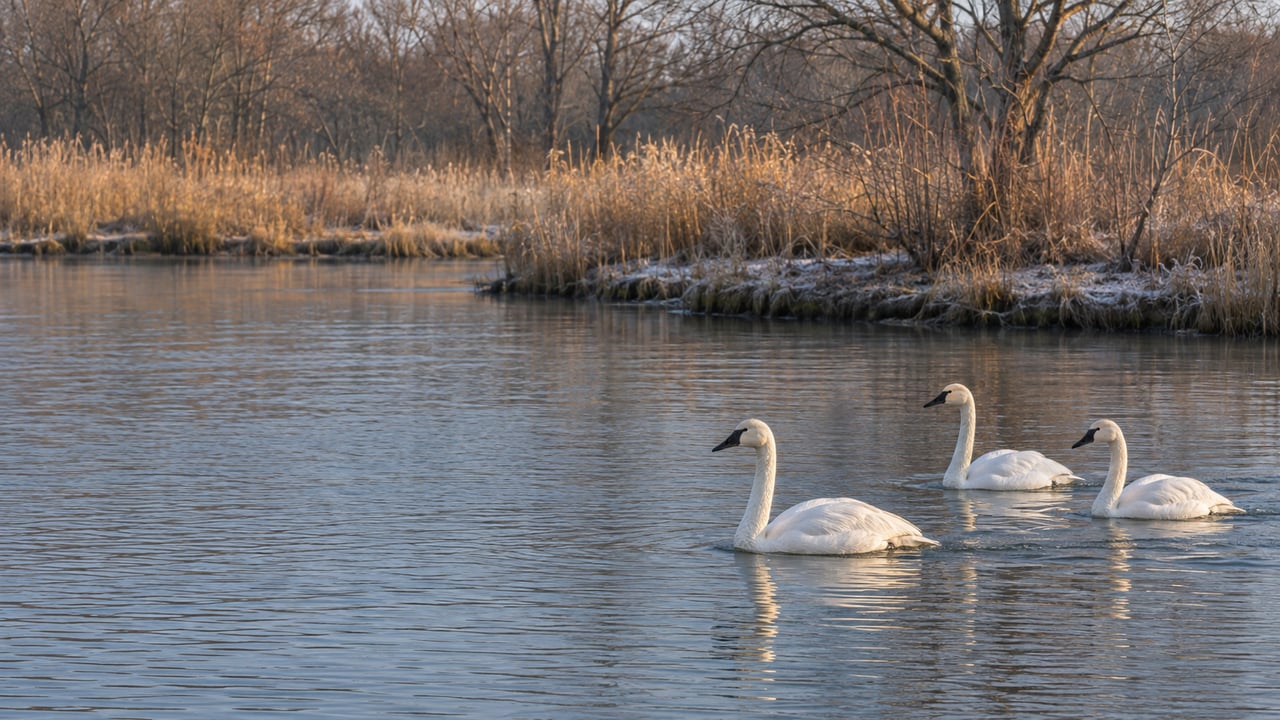
Where to Watch Easton's Winter Ducks, Geese and Swans This Season
November 19, 2026
November 19, 2026
For most of the Talbot Bird Club's winter outings, the meeting spot is the Easton Acme parking lot. The club's calendar gives its coordinates, 38°46'47"N 76°04'57"W, and nearly every trip from early November into December leaves from there, usually at 6:30 or 7 a.m. The decoys and paintings of Waterfowl Weekend have been packed away. The live birds are just settling in, and this is the stretch when you can see them close to home.
The club's November schedule shows how the season works. A November 8 trip to Kingston Landing and Environs listed waterfowl, horned larks and pipits as expected species. On November 10 the club's meeting speaker was Blackwater National Wildlife Refuge biologist Matt Whitbeck, whose talk was "Waterfowl habitat initiatives at Blackwater." A Bombay Hook trip went out on November 15. All of those field trips started in the same Easton lot.
Here is what's still ahead on the Talbot Bird Club calendar:
The December 12 trip is the one closest to home. It stays in eastern Talbot County, among the public landings that most of us drive past on the way somewhere else. The listing gives a leader and contact for anyone who wants to ask before showing up.
How many birds you see depends on how cold the winter turns. Each January, pilots and biologists from the Maryland Department of Natural Resources and the U.S. Fish and Wildlife Service fly the state's Chesapeake Bay, tidal Potomac and Atlantic shorelines and count the ducks, geese and swans spending the winter there. In the first week of January 2026 they counted about 926,900 birds. The year before they counted 705,300, and the five-year average is 684,280. DNR said the extra Canada geese and diving ducks "likely reflect the cold weather" of that December and January.
The species breakdown from that January 2026 midwinter survey shows where the jump came from. Diving ducks reached 239,100, compared with 100,200 in January 2025. Scaup rose from 36,900 to 105,800, and ruddy ducks rose from 9,700 to 72,300. Canada geese reached 509,400, up from 414,200, and tundra swans reached 16,900. In the 2022 survey, tundra swans numbered 7,400. Dabbling ducks went the other way, slipping from 126,000 to 117,300.
The dabbler and diver difference matters when you pick where to go. In the Talbot Spy's Bird's Eye column this month, Bill Hubick of the Maryland Biodiversity Project explains that dabblers like teal, shoveler, gadwall, wigeon, mallard, black duck and pintail "tip up" to feed just below the surface. Divers like canvasback, redhead, scaup, bufflehead, goldeneye, the mergansers and ruddy duck swim underwater after their food. Divers also have to run across the water to take off, while dabblers lift straight up.
In practice, that means freshwater ponds and wetlands are best for dabblers, and open river and coves are best for divers. Hubick also writes that "as winter temperatures drop, ice can displace large numbers of waterfowl, which may then congregate anywhere with open water," and that flocks of Canada geese, snow geese and tundra swans "can suddenly materialize in an open field." So the best day to go is often the first clear morning after a freeze, when the shallow ponds have iced over and the birds have crowded onto whatever water is still open.
Pickering Creek Audubon Center has more than four miles of trails, bird blinds and platforms, and freshwater wetlands. Its brochure says winter brings abundant Canada geese along with green-winged and blue-winged teal, northern shoveler, pintail, black ducks and gadwall. In other words, it's a dabbler site, which fits the wetland habitat.
Admission is free, and there are gravel lots by the Welcome Center and the dock. Stay on the marked trails, carry out what you carry in, and leave the dog at home, because dogs are not permitted. The center's brochure lists winter hours of 7 a.m. to 5 p.m. Confirm the current hours before an early start.
Pickering Creek's program calendar has two December dates that fit this season:
The December 5 program falls on the same day as the bird club's Blackwater trip. If you join that 6:30 a.m. departure, you should be back in time for the afternoon session at Pickering Creek.
Pickering Creek also has a quirk. The Birder's Guide puts the center's waterfowl peak from mid-March through April, so it's worth going back in early spring.
Wye Island Natural Resources Management Area is the larger, wilder option. The Birder's Guide to Maryland and DC lists it as a winter waterfowl destination, with 28 waterfowl species in eBird reports from the site. It is open sunrise to sunset and free. Dogs must be leashed, there is plenty of parking, and parking on the road shoulders is not allowed. Wye Island is also an active hunting area, so check the DNR schedule before you go and wear bright colors on the trails.
Tuckahoe State Park has the 60-acre Tuckahoe Lake, which the Birder's Guide rates as good for winter waterfowl. It has an eBird hotspot at the picnic area by the lake. Maryland DNR lists the park as open sunrise to sunset, with a boat ramp and trails. The Birder's Guide lists free entry, parking lots, and pets allowed in day-use areas. Public hunting is permitted in the park, so the same caution applies there. The DNR's Tuckahoe page is the place to check before you load the car.
Closer in, Easton Point Park is a free waterfront park on the Tred Avon with trails, benches, picnic areas and a kayak launch. The town's 2026 comprehensive plan describes a small marina and a heavily used public boat ramp at the tip of the peninsula. For anyone living in Easton, it's the closest open tidal water, and a reasonable place to check after a freeze before driving somewhere bigger.
The Christmas Bird Count is where all of this watching gets written down. The Maryland Ornithological Society sets the count period from December 14 through January 5, and each count circle takes one day within it. The St. Michaels count is on Sunday, December 20, and the listing asks participants to contact Wayne Bell for details.
The St. Michaels circle has a recent record of its own. In Audubon's summary of the 125th Christmas Bird Count for Maryland and Delaware, published November 2025, the St. Michaels count recorded 86 hooded mergansers, flagged as a high count. Only Loch Raven, with 291, and Crisfield, with 192, reported more of them that year. The same summary listed a single cackling goose for St. Michaels. That's the small look-alike of the Canada goose that Hubick says can turn up "wherever you find concentrations of geese."
Hooded mergansers are divers, part of the group whose statewide numbers jumped in the cold January of 2026, so the St. Michaels tally this December is one local measure of how this winter compares.
Watching which creeks stay open after a cold snap tells you a lot about the shoreline along it, including how sheltered a cove is and how the water moves past a dock. Tracy Higgs Wagner grew up on the Sassafras River and pays attention to those details when she looks at waterfront property. If a winter morning on the Tred Avon or the Miles River has you thinking about a view of your own, Let's Connect.
Stay up to date on the latest real estate trends.








Get assistance in determining current property value, crafting a competitive offer, writing and negotiating a contract, and much more. Contact me today.